Kaid Nygren & John Paul Koch: College Students (Not Kids)
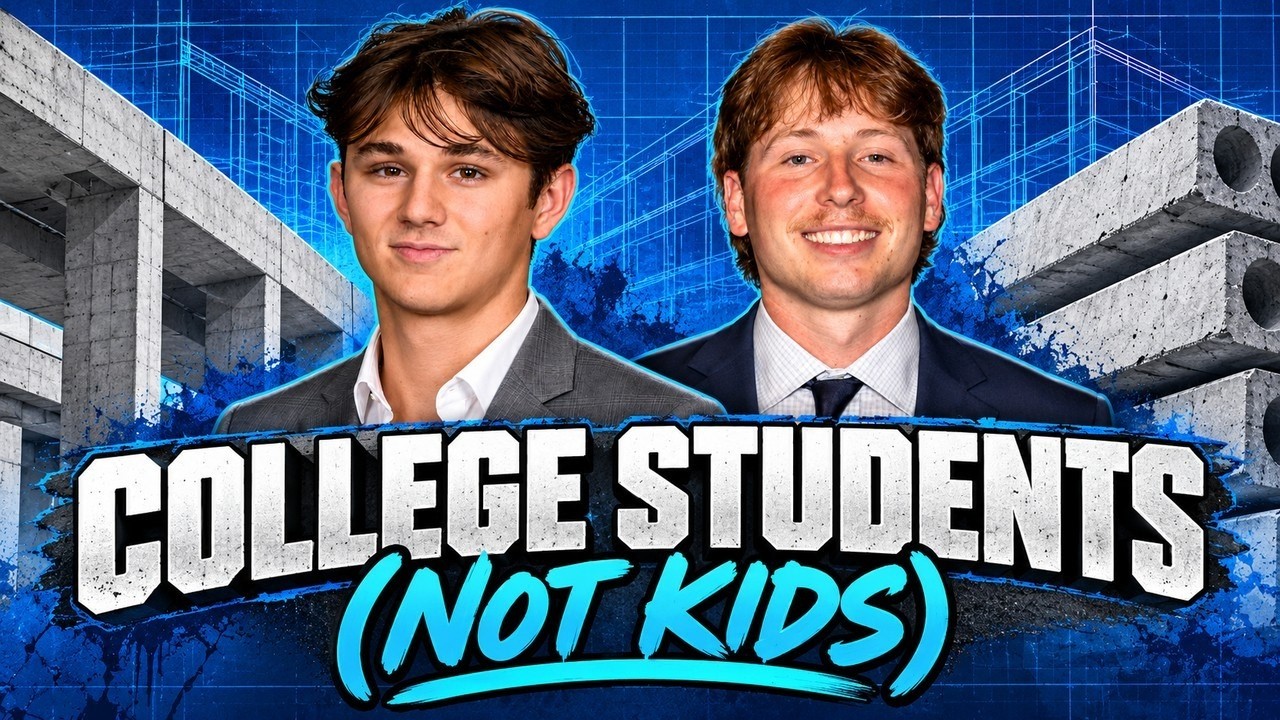


In this episode of The Blueprint Podcast, T.J. Crosby and Joel Galloway sit down with Kaid Nygren and John Paul Koch, two Texas State University Concrete Industry Management (CIM) students, to discuss how they found their way into the concrete industry, their experiences with internships and hands-on industry work, what they’re learning through CIM, and their perspectives on attracting the next generation of talent. They also share their career goals and hopes for the future, highlighting why college students entering the industry deserve to be treated as the future professionals they are, not just kids.
Music licensed from PremiumBeat
Track: Orange Sunset – One Wave
Code: LFXMSDZY7M2GOM5O
Joel: Welcome to the Blueprint. I'm Joel Galloway, and today we've got two guests who represent the next generation of the concrete industry. We're joined by Cade Nigren and John Paul Cook, both students in the concrete industry management program at Texas State University. Cade has already gotten some great hands-on experience in the industry, including time with Locke Solutions and more recently Orion, where he stepped into an interim project engineer role over the summer. JP has gained experience with both Kent companies and Tyndall, working in areas ranging from sales to quality control. He was also recently a guest panelist at AgNexus discussing the future of the workforce in the concrete industry. We actually met these guys earlier this year at the pre-cast show in Kansas City when they came up to talk to us. And they've been following the podcast, and now we've come full circle, and they're our guests. So here we go. Cade and JP, welcome to the blueprint. We are so glad to have you guys here. You doing okay today?
Kaid and JP: course. Thanks for having us. Doing great. Yeah.
Joel: Yeah.
Kaid and JP: Thank you.
Joel: Awesome.
T.J. Crosby: That's awesome.
Joel: Well, what the viewers don't realize is that we all feel like we're friends, right, TJ? Like we met these guys.
T.J. Crosby: If we we might be privileged enough that they would call us friends. I'm not sure I'm not sure they would go that far.
Joel: Yeah, they I mean they weren't just referring to us as sir a moment ago. So I I don't know.
Kaid and JP: That's just the Texas in us.
Joel: Yeah, that's right. That's right. Yeehaw, howdy. Yeah, you're from Texas, I can tell. Yep. Yep. So
T.J. Crosby: Yeah. Maybe we're cool enough for them to call us friends. We'll we'll say we'll take that. We'll take that win. Yeah.
Joel: we're TJ and I are at the precast show in it's Kansas, right? Kansas City. And and these two guys walk up to us. It's our first we've only been doing the blueprint like what? Like about, I don't know, we've done like five episodes maybe by that point.
T.J. Crosby: Maybe if that maybe three at that point, no. Or two. I
Joel: Not even that many. And they're like,
T.J. Crosby: don't know.
Joel: we know you guys from you t from from LinkedIn. We know you guys
T.J. Crosby: Right.
Joel: from LinkedIn. And we're like, what? Is is this show is this show really changing
T.J. Crosby: Are we famous?
Kaid and JP: Celebrities. Y'all are Can we get a photo?
Joel: lives like we hope?
T.J. Crosby: It's a can we get a photo? Can we get your autograph? Hold on, let me practice
Kaid and JP: Yeah.
T.J. Crosby: it first. I don't know how to do that.
Kaid and JP: Yeah, so Kate and I were walking around the trade show floor and he been sending me like the the blueprint or what is it concrete careers LinkedIn
Joel: Concrete careers.
Kaid and JP: and he's like dude these guys are here we gotta go and we were kind of beat from like the whole like pre-cash show we're kinda tired and we're
Joel: Yeah.
Kaid and JP: like all right yeah last stop last stop and then we go over there and I don't know we we became instant friends. I
T.J. Crosby: Yeah.
Joel: absolutely.
Kaid and JP: you are definitely friends so
Joel: Well, I mean, it's us. Like we're just regular folks. Like I mean, we love being friends with people. And you guys are great. So it was just a match made in heaven, right?
T.J. Crosby: Yeah, yeah, for sure. That's fine.
Joel: That's awesome. So did y'all enjoy the show? you said you were beat. I mean, th the shows are I mean, they'll wear you out, won't they?
T.J. Crosby: A lot.
Kaid and JP: Well, we were beat and then we came over to y'all and it was like taking an espresso shot or something. That woke us up.
T.J. Crosby: That's the effect Joel has on people, you know. Yeah. Like an espresso shot.
Joel: Clip that. Clip that. That's what we need. We want to be energizing. We want people to to be bet be
Kaid and JP: Yeah. Yeah.
Joel: be hyped after they come to our booth, right?
T.J. Crosby: Yeah. Well did y'all did y'all see
Kaid and JP: Yeah. No good.
T.J. Crosby: the did y'all see the clip of Joel's experience at the precast show versus TJ's? Did you happen to see where it was it was Joel's it was Joel's first
Kaid and JP: I think I might have but I I don't remember exactly
T.J. Crosby: show and it's like he's like, I'm having the greatest time of time of my life, you know? And then it cuts to me just working at the table, you know. And so right. Yeah.
Joel: That's right. And TJ's over there. Yeah, TJ's answering emails. Hello, sorrow, my old friend.
Kaid and JP: Yeah. Yeah. I think we were kind of talking about that at the show about how y'all have a similar relationship to JP and I. JP's kinda
T.J. Crosby: Right. Yeah.
Kaid and JP: like Joel and T J or and I Yeah, that's so true.
Joel: I'm so glad we already are getting to the good stuff here. You're absolutely right. JP and I are kindred spirits. And Cade, you and TJ are locked in for sure. Like,
T.J. Crosby: Yeah. Right. Yeah.
Kaid and JP: Yeah. My man. Yeah. Right and
T.J. Crosby: You know, filming the content. Okay.
Joel: just just JP, I just want to be real though. Just just make sure you're paying attention which one of the two of us owns a company. Okay. I'm just saying it it has its perks, but
T.J. Crosby: Ha ha ha.
Kaid and JP: Yeah.
Joel: you might not be the boss.
T.J. Crosby: Yeah.
Joel: I don't know.
Kaid and JP: Yeah, it's it's alright. I don't I don't need that responsibility.
T.J. Crosby: that's funny. You both you both have a teleportation.
Kaid and JP: I just wanna talk to people and do my thing and he can run everything.
Joel: Me too. I don't want to do spreadsheets all day. Cade and TJ. Y'all do that. Me and me and JP gotta go talk.
T.J. Crosby: Kate
Kaid and JP: Yeah, I got it.
T.J. Crosby: Kate I are gonna to have our own podcast. We're gonna have to have y'all just record by yourselves and like okay now we're gonna talk about business and stuff. Like well, so tell me
Joel: That's right.
Kaid and JP: Yeah.
T.J. Crosby: more about the the structure of that concrete mix that you came up with. I mean, how did you incorporate type one L into that mix? It seems like
Kaid and JP: Seriously.
Joel: And me and Kate are gonna be like, did you see the AM game last week? Like, are you serious?
Kaid and JP: Yeah.
T.J. Crosby: I love it.
Kaid and JP: I so I'm pretty
Joel: Okay.
Kaid and JP: ADHD, so my my train of thought can jump from like bottom to like anywhere, you know. Spontaneous
T.J. Crosby: Yeah.
Kaid and JP: questions on a second. And I realize some people don't work like that and so they have a hard
T.J. Crosby: Right.
Kaid and JP: time following.
T.J. Crosby: Yeah. Yeah.
Joel: Ask T J I do. It's like somebody's flipping the channel
Kaid and JP: Yeah.
Joel: in my brain.
T.J. Crosby: Right, right. There's times like or the times I'm like, I'll get y'all well let's like let's get back to this. He's like, yeah, yeah, yeah, my bad. Right, right,
Joel: Let's go back to the thing.
T.J. Crosby: right.
Joel: But hey look now, I can always
Kaid and JP: Yeah.
Joel: tell you the pinball effect that got me from him saying what he said to where I was. There's always a reason. It's
Kaid and JP: Yes. Yeah. Thank you. Yeah, there
T.J. Crosby: That's right. That's right. That's right.
Kaid and JP: is a train of thought, but you don't verbally like yes.
Joel: It he I say it like this. There's a train of thought, but there's only one seat to ride on it. And so nobody
Kaid and JP: Yeah.
Joel: else gets to go.
T.J. Crosby: I would I would say it's probably more like a train that transfers to a boat, that transfers to a helicopter, that transfers to a cruise ship, that transfers back to a car, then then back onto the train. That's probably
Kaid and JP: See, no that makes me think of my CIM experience. If I'm being honest. Yeah.
T.J. Crosby: And and fun fun
Joel: You've done it all. Okay, well
T.J. Crosby: plug, if if the people listening haven't watched the weekly app, helicopters were featured on this week's episode. So
Joel: Yes, that's
Kaid and JP: Right.
Joel: right. We did talk about helicopters. You should go check it out. Weeklyap.com, weeklyap.com.
T.J. Crosby: Check it out.
Kaid and JP: I did see Nick Saban is Cali's father.
T.J. Crosby: That's right. The next statement count is that. We learned that last week. So
Kaid and JP: Yeah.
Joel: Here is
T.J. Crosby: yeah.
Joel: the best part of all of this. You guys are so real. Like 'cause you were like, we like y'all stuff. And then here you are dropping references that we're like, we don't even know if anybody watches this stuff. Like we no.
T.J. Crosby: Right. Yeah.
Kaid and JP: Yeah.
T.J. Crosby: Right. Meanwhile meanwhile Cade's like Kate's like, yeah, so the the next concrete cool thing you guys should make sure you mention. Smith, you know, like yeah, man, that was hilarious.
Joel: Is it poop creet? Is it poop crete? I don't know.
Kaid and JP: Kate's waiting to get to the business. Yeah, I'll let
T.J. Crosby: Right.
Kaid and JP: I'll let JP do the fun stuff and then I'll start chiming
Joel: Yeah.
Kaid and JP: in. Hey, but that's why it works, right?
T.J. Crosby: That's right. It it's it's a good dynamic. Yeah. That's right. I tell you, we've we've we've recently Yeah,
Joel: That's right, you know, match made in heaven. You got Batman and Robin. Mean me and JP are Robin. Like we know it. We're good. So
Kaid and JP: J wants to be Batman.
T.J. Crosby: hey, as you Batman, Superman, whatever the case, like it works, you know.
Kaid and JP: Yeah, hey,
Joel: That's it. So guys
T.J. Crosby: what made you guys decide to get into it? This this space?
Kaid and JP: how did I get into the industry? Yeah, so I had started actually working around I think it was fifteen, going on sixteen in Mama Margie's Mexican restaurant. just fast food. So like I got a job very early on and I was still in high school and all my friends would be like coming through the drive-thru and they're like, Bro, come on, come out, like we're all about to go go do something fun. And I'm like, I'm like in there making bean and cheese, and I'm like, my gosh, I like so frustrated. But very grateful looking back now, because I'm like, wow, that taught me how to work. And like ever since then my work ethic developed. So I'd before coming into the industry, I hopped around fast food, the fast food industry a lot. So I was a server. And being a server teaches you something that I don't know, it just teaches you something that everyone needs to know.
T.J. Crosby: Mm-hmm.
Kaid and JP: serving people, because every day in the industry you're serving somebody, right? it teaches you people skills. and I think everyone should do some kind of fast food and be a server. doing that taught me a ton. but long story short, I worked fast food, Mama Margi's Chipotle, and I was just so tired of it. And then it was freshman year or sophomore year when we had chemistry together. like chemistry class.
T.J. Crosby: chemistry class. He's like he's like he's like he's like our our bro chemistry was before that, but chemistry class are you, right?
Kaid and JP: Yeah, so just a display. Yeah, yeah, hey. Well
Joel: Ha ha.
Kaid and JP: explain why you switched to CIN. I'm getting there, I'm getting there. So
Joel: This is the plane to the boat to the
Kaid and JP: Exactly.
T.J. Crosby: Right. Right.
Kaid and JP: This is the most ADHD thing I've ever heard. He just went on a tangent while he did brush the restaurant business. Like there's a train of thought, okay? So I was
T.J. Crosby: Right, right. That's good. That's good.
Kaid and JP: I quit Chipotle my sophomore year, and I was looking for a job. And at that time I had just met Kate and the friend group in college. And we were in chemistry together, that class, and And he was like, hey, I just got a job at this concrete plant in Butah. Would you like to come work with me? And so I actually I sent my my resume in and I went in and had an interview. And I actually started working there a week before he did. Although he was like the initial contact and like he was guaranteed a job there basically. And I was just like interviewed and and brought on, but I started before him. so I got into the industry because I was doing fast food and going to school and I wanted to be have something competitive, like a competitive edge. because prior also I was bear with me, bear with me. I was I came into college as a business administration major and I was like, okay, here I am no different than this guy right next to me, this guy right here, her over there. Like we're all the same and so I was like okay I need to be competitive and I was talking to my mom and she had just gotten a new boyfriend at that time and actually stepdad I think it it had progressed that that far already and he was a project manager and she was like you should go check out the construction industry and I was like hesitant. I was like okay well I'm fine like Yeah. and I went and talked to Ryan Finn Larry like a week later. And ever since then I joined CIM. I went head first into all the opportunity and it was truly a blessing from God. And everything
Joel: Awesome.
Kaid and JP: that came after that was just like a gift. And very thankful for that. so that is my story of how I found CIM from years ago to here. Yeah.
T.J. Crosby: Love it. Love it. Yeah.
Joel: Okay, okay.
Kaid and JP: Yeah,
T.J. Crosby: Yeah.
Kaid and JP: so I did not have any family connection to the construction industry whatsoever. I mean, I had I have a cousin that is a project manager, but That had nothing to do with why I joined the construction industry. But I as well started off in business administration and same thing. I'd felt no purpose. I didn't know why I was going to school for it. I didn't know what the end goal would be. So I kind of thought about it and I grew up doing a lot of hands-on work. I would mow people's lawns and pressure wash. So I was like, okay, maybe I'm more of a hands-on, outdoor type of person. So first thing that comes to mind, construction. so I I actually switched my major originally to construction science and management, just the general construction. And of course, Ryan's the intro teacher to that class. So
T.J. Crosby: well played.
Kaid and JP: Obviously he's gonna promote the CIM and the CIM to us. And
Joel: Got Got
Kaid and JP: he talked about all the scholarship opportunity, the travel, and I told my mom about it and she was like, scholarships, yeah, you should switch your major. So I switched my major and same thing as JP. I kind of dove headfirst into it and ended up loving it and took off from there.
T.J. Crosby: It's amazing. Yeah. I have a I've often said to to younger people, Mama knows.
Kaid and JP: Yeah.
T.J. Crosby: you know, they oftentimes I'm saying it whenever they they think they were able to sneak into the house when they were younger and she didn't know about it. I'm like, Mama knows, mama knows. but also mama knows about those kinds of things like to set you up for a good career path. and or how to make sure you're financially stable when you get out, having the scholarships. that's huge. To leave with less
Kaid and JP: Yeah, for sure. I think
Joel: That's right.
T.J. Crosby: debt and Better employment is a a good thing. I'm
Kaid and JP: Yeah.
T.J. Crosby: sure.
Kaid and JP: I think one thing that helped us realize how much we loved the industry was starting to work early in the industry.
T.J. Crosby: Mm-hmm. Mm-hmm.
Joel: Mm-hmm.
Kaid and JP: we I joined CIM probably my second semester freshman year but started classes for it my sophomore year first semester and I actually did an internship before I even took any CIM classes with Locke. So I did my LOC internship and then from there lone star precast reached out to me, they saw me on LinkedIn that I did an internship and was in the CIM program and said they asked if I wanted to come work for them during the school year and I it's like why would I turn down that opportunity? So started working there and got JP the job and that's kinda how it all started and
Joel: Even even though he beat you there, but that's neither here nor there.
Kaid and JP: Yeah, even though we needed
T.J. Crosby: Yeah.
Kaid and JP: started the first session, but that was just
T.J. Crosby: Right. Right. Right. In fifteen years the story
Joel: Mm-hmm.
T.J. Crosby: is JP's like, I'm pretty sure I was there first. I think I might have gotten you the job. I mean, to real honest. I mean, yeah, right. Like they're they're not around.
Kaid and JP: It's just great.
Joel: Yeah, yeah. And and we can't verify it 'cause it doesn't exist anymore. So
T.J. Crosby: We can't check the records. I think pretty sure I was there first,
Kaid and JP: Yeah.
T.J. Crosby: you know.
Kaid and JP: I'm like I have three years of experience in the concrete industry and JP's like, Well I have three years in one week, so
Joel: Ha ha
T.J. Crosby: It's like when t when twins are born, the one that came out first, you know, they're like, I'm the older sibling. Yeah, right. That's funny.
Kaid and JP: Yeah. That's
Joel: Yep. I'm one minute older.
Kaid and JP: funny. It it really was like twins were born into the concrete industry. Yeah.
T.J. Crosby: Right. Yeah. Yeah, that's cool. I I say the food service. So I worked my first job was Mc McDonald's. I would ride my bike up to McDonald's to work there when I was fifteen. obviously just working the register because I w I came I started working not too long after some of the the labor laws had changed to make sure you had to have a work permit and all that kind of stuff, but at
Kaid and JP: Yeah.
T.J. Crosby: least in North Carolina you did. And but I worked there, I was there there in college still. I was waking up at three thirty in the morning to go make biscuits at four thirty when I was in college for a little while. I left that behind pretty quick once I got a job at the bank instead. I was like, but my my my degree was business
Joel: Yeah.
Kaid and JP: Yeah.
T.J. Crosby: business management, so business administration. And then I doubled down, I got an MBA too. But
Kaid and JP: Mm-hmm. Yeah.
T.J. Crosby: when I got out with my business degree, I'm like, like out of college. I'm like, let me get a job managing people. They're like, that's cute. You're gonna go do other stuff. And so I think it's
Kaid and JP: Yeah. Yeah.
T.J. Crosby: really wise you've made the move into a more specific focus because it's a
Kaid and JP: Mm-hmm.
T.J. Crosby: lot more employable. The business management degree, you're just kind of the path to go be in like generic sales for however long.
Kaid and JP: Yeah.
T.J. Crosby: Well it's it was a good career. I mean I I did okay, but definitely definitely not.
Kaid and JP: Mm. And the the CIM degree sounds very specific, but there's such a broad amount of opportunity that you can do within the concrete industry. So yeah.
T.J. Crosby: Right. Right. And I would say, I mean, Orion, Kent, Tyndall, Locke, those are those are brands in the industry that are very well regarded, well known.
Joel: Yeah.
T.J. Crosby: I mean, and they're but even even outside the industry, just compared to other companies in general, they're incredibly strong organizations,
Kaid and JP: Yeah.
T.J. Crosby: period. So you guys are you guys are on a good path. I'm excited about that.
Joel: What do you th what
Kaid and JP: Yeah.
Joel: do you think's been the most surprising part for y'all from about being in the CIM program? Like what's what's one thing that's jumped out that maybe wasn't like you expected it to be? Good, bad, interesting, funny? I don't know.
Kaid and JP: I'd well I'd say that one thing that has stuck out the most that I didn't really I guess consider going into it is how much like relationship driven the industry would be. going in I I honestly didn't know that I guess how business oriented the industry would be rather than, you know, swinging a hammer every day or being out on a job site. There's a lot more to it that kinda stuck out to me.
T.J. Crosby: Mm-hmm.
Kaid and JP: I would second that the relationships really were surprising and amazing. Kinda how you said before, like, The industry is not snuffy like the s or snotty, like the people in here are very down to earth, very grounded and I I think I was just very surprised that the amount of professional men and women who wanted to mentor the younger generation who were like
Joel: Yeah.
Kaid and JP: who were just looking for someone to come say hello and introduce themselves and then call later when they have a problem in XYZ out in the field or in the plant or something and like because they found a love for it and now that we are they really want to mentor that and and like I think that was the most surprising is how many professionals were willing to kinda humble themselves in all the
T.J. Crosby: Mm-hmm.
Kaid and JP: the
Joel: Yeah.
Kaid and JP: questions that I would ask, even if they were like kinda self-explanatory or or you know a definitely lower level question, but I I was just appreciative of that, you know.
Joel: feel like for there being I mean obviously there you know there's a rising number of ladies that are in the industry which is cool to see but for a typically male dominated over you know historically industry there is a lot more nurture would be the word that I would that I would think of in
Kaid and JP: Hmm. Yeah.
Joel: this industry like what you're talking about. People willing to mentor, people willing to take you under their wing. That is not classic man vibes. You know what I'm saying? It's just I mean, I there always has been pee men who would do it, but on this scale, I feel like it is really cool. That has been something I've been so happy to see and benefited from myself being new to the industry mom. So I think that's really cool. I'm glad you guys are experiencing it.
Kaid and JP: Yeah, for sure. I mean when you think of the construction industry you think of grumpy people that, you know, hate going to work every day and then you go to these industry conventions and everyone's super nice and welcoming stuff kinda catches you off guard. Yeah.
Joel: Well, the thing that's cool too is for you guys, I feel like you already are starting this, but that will help you see the value in returning that, like passing that down, paying it forward to the next generation. Cause one day you both will be the one somebody comes and wants to meet or talk to or have the opportunity to to share advice. And you will have an entirely different heart for that because
Kaid and JP: Yeah.
Joel: you know what the ones before you have poured into you. And so I just
Kaid and JP: Okay.
Joel: think Such a such a cool path.
Kaid and JP: I mean we we already kind of see that today with being, you know, upperclassmen and having underclassmen come in.
Joel: Just just wait until this episode debuts. I mean you'll be famous. I'm just
Kaid and JP: Yeah. Yeah. Yeah. Bob I made it.
T.J. Crosby: Right. I will say that speaking of the moms, that was that was really cute. Like after we made the post on LinkedIn,
Kaid and JP: Yeah.
Joel: Yes.
T.J. Crosby: like the parents showing up being like, hey, that's my boy, you know, that was
Kaid and JP: Yeah.
T.J. Crosby: pretty cool. It's that's LinkedIn has been around long enough now that like the this new generation's coming in. It's pretty neat that like parents, and it's regular now that I'll see like a parent announcing that their kid is graduating college and looking
Kaid and JP: Sure.
T.J. Crosby: for a job. I'm like, wow, that's and I know I sound like an old guy right now. But I mean LinkedIn has been around for a while. But for us, it still feels like it's like a relatively new thing, you know. But
Kaid and JP: Yeah.
T.J. Crosby: anyway. Yeah, right. We we were we were in college whenever Facebook
Joel: Back in my day.
Kaid and JP: I was gonna cover it and say, you don't sound old and then
T.J. Crosby: was freshman Facebook. It was only for college students. That's we are right. Yeah. Yeah.
Joel: Yes. That's yeah. You had to have a school email address to get on Facebook in the beginning.
Kaid and JP: Yeah.
T.J. Crosby: Yeah, once upon a time.
Kaid and JP: Yeah.
T.J. Crosby: So
Joel: No, you're fine.
Kaid and JP: Just like continuing that conversation, I think I've seen like there are a lot of women coming up in the industry and it's great to see. I've seen I think it goes back to the point of the industry is very family-based because
T.J. Crosby: Mm-hmm.
Kaid and JP: I've seen a lot of fathers bring their daughters into the industry and it's just it's great to see that kind of growth. and see that the industry is going that way 'cause that's very sustainable and like and it's just really good to see. And then
T.J. Crosby: Mm-hmm.
Kaid and JP: also going on to the point of like us giving back, I know Kid kinda mentioned, yeah, we've already kind of start feeling that way. I think we both experienced it when we were Officers of the ACI student chapter. And we had freshmen or sophomore coming into the program asking all these questions that we had just asked. Like, and to be able to give them an explanation, but coming from their shoes, because we had just been there, I feel like we were able to give back in a different way, and that it may more sense like they were able to wrap their their head around what we were saying because we said it from the exact same shoes. so I think that was just a great way for us to give back and and also like just to serve serve the industry again by going out of our way and and A CI officer and bringing industry professionals in as well. so we served the industry as well. was it was a really neat position to be in because we could have industry professionals come in and we'd you know they want the future of their company to flourish and we'd have them provide with for them internships and opportunities to meet young talent. but it was just a great gift. So I I think that was just one way that we could serve and get back.
Joel: I think it's important too to point out with that. I think we all are guilty of thinking that we can't influence sometimes without having like years of experience, like being like Sage and the gray hairs coming in and you know, all that kind of stuff. And I mean, you're talking about right there that you went
Kaid and JP: How did it
Joel: you you walked right from being the one asking the question to being the one answering it, like in a year. You know what I mean? And so
Kaid and JP: Yeah.
Joel: I think that's really encouraging that you guys can You can make an impact regardless of where you are on the journey. You don't have to have it all figured out to be able to help the next generation.
Kaid and JP: Yeah. For sure. Well what I find it's a very interesting topic on that. And I know I was in a room where they kind of mentioned this, the National Steering Committee and Ryan. but they're they said that it's interesting 'cause you have these high school students who come into college and then they're in it for a year or two and then on the flip side when they become a junior senior, there's a such a quick turnaround of like, Hey, we want you to to start leading and like give back to people. So there's so much personal growth in those first two years that people don't realize and then the expectations come on heavy in the next two. I just thought that was a really good point of like young talent coming in and being molded. but the CIM
Joel: Yes.
Kaid and JP: program has done a phenomenal job of providing resources to students in those times because it's more of a community, you know. And that's that's honestly one of the things that we do when giving back to the underclassmen or teaching them how to do things is telling them that, you know, you don't have to have all the experience. Look at us. We didn't know what we were doing a year or two ago. You can I mean, you'll figure it out as you go. So you just have to
T.J. Crosby: Right.
Kaid and JP: volunteer, take every opportunity you get and you'll figure it out.
T.J. Crosby: Yeah, it's amazing. It's it's very much which makes sense in the construction space, but I think the CIM program does this particularly well, but it very much seems like an apprenticeship style program as opposed to it's like a blended, not just a traditional college degree, but it has like the apprenticeship aspect of it. You know, the internships so like early, the involvement in the industry, you're learning at a much deeper level than you do in a traditional degree. Most degrees don't have that much applied learning.
Joel: Right.
T.J. Crosby: early on. Like even engineering, oftentimes it'll do a co-op or a internship kind of the last couple of years of school. but you still come out typically have to learn kind of boots on the ground after you graduate. But you guys in the CIM program are much more equipped to come out and make an impact day one once you go on full time, you know.
Joel: Yes,
Kaid and JP: Yeah.
Joel: one hundred percent.
Kaid and JP: I mean it really is what you put into it. obviously there's people that don't really take as much opportunity as we might have, but
T.J. Crosby: Maybe.
Kaid and JP: I mean, we see all the time that in in our degree in our degree program or our degree we're only required to do one internship after our junior year, but There's so many people that we've seen start internships or freshman year and do one every single summer. So I will give praise to a lot of people that are kind of going out of their way to do that on their own and take the initiative.
T.J. Crosby: Yeah, it's awesome.
Kaid and JP: Yeah, and kind of going back full circle to what how we started of us coming into the industry, like Cade said, when we were working, that's when we really started falling in love with the the industry and the program. Cause we worked at Lone Star Precast in the quality control department as interns doing slump unit density air all day, every day. And at first we were like, or at least I'm talking for myself. I'll talk for myself here. I was like this is very repetitive and kinda as a young at like a a young person coming into college I was almost entitled for opportunity I would say and I got more I got aggravated doing the same task over and over. until
T.J. Crosby: Mm-hmm. Mm-hmm.
Kaid and JP: we had to do our ACI field one in school and then it all clicked and I was like, my gosh, I actually like from what I thought was like a paid job that I had to go in and do every day, I actually love this now 'cause I can like I can do this, get a certification really well, and then going forward from there, I I kinda opened my eyes to like, okay, yeah, like what we were doing was really relevant and it's relevant to the industry and those experiences that I had, I could talk to people at conventions or conferences and they would be able to resonate with that and we could build relationships off of internship experiences that you know we shared. So Yeah, going off of what he said But think being in the industry really helped us. I mean I'm kind of repeating what he said, but being in the industry helped us figure or see how relevant ever all the class material was. Not
T.J. Crosby: Mm-hmm.
Kaid and JP: working in the industry, you kind of it's just like a business degree,
Joel: Yes.
Kaid and JP: you know, you don't realize how relevant that stuff you might be learning is. And I think that's kind of what set CIM apart is with that industry experience it's easy to see how relevant it is.
T.J. Crosby: Yeah, and it's one thing you guys meant because in your you have your live experience, right? But the oftentimes other internships or other co-ops or whatever, you have some level of involvement in what the business is doing. But for the most part, you're doing very menial tasks that you're sort of just in the building around people. You're not really involved in the actual product that the company is creating or producing. Maybe with the exception for maybe some some marketing internships. I could see them being involved in some. things potentially, but you're not really getting into like all the marketing strategy and all of that kind of stuff. I know, you know, business lifetimes business internships, you're getting the mail and getting the coffee kind of kind of a thing, right? It's it's more about what you can do for the business than you learning. But
Kaid and JP: Yeah.
T.J. Crosby: what you guys are doing with like going and doing the, you know, getting the the the cylinders and all that and doing the it is repetitive, but you learn it so well that it sort of wrote by the time you get back into the actual certifications and all that stuff. It's just cool to see that You're getting that really applied learning, actually being involved in part of the process is what the business is doing. Because they're not gonna produce extra concrete over here for you to test and like the mini drum, you know,
Joel: Right.
T.J. Crosby: whatever like that, you know.
Kaid and JP: No, you're yeah. You're in the arena, you're you're in the action, which
T.J. Crosby: Right. Right.
Kaid and JP: is what students want. They want that value, they want that responsibility. 'Cause when I f felt like what I was actually doing, if I could get in trouble for messing up, then I was like, okay, like I I actually need to step up my game here. like I think Ryan said this really well on the panel at AGGNEXUS. We were talking about The workforce apocalypse, in the new generation, like is this generation do they have a lack of work ethic? But he was saying no. He said, What I think is that this generation is not being challenged properly because they have a different set of skills, but they're equally and and like equally as hungry as generations before have ever been. And so he was just saying we need to upgrade how we challenge the new generation, how we challenge students coming in. Our internships programs need to be catered more to like giving them responsibilities and and stuff like that so that students can actually grow through through that. I think a big part of that too is having as a student having the confidence to go ask ask to be in those positions. And I think that's kind of why JP and I have been as successful as we have been so early, because we're not afraid to tell people to put us in those positions. And
T.J. Crosby: Mm-hmm.
Kaid and JP: I mean, I give credit to all the companies I've worked for. When I ask to be in those positions they say yes and I agree with what JP said that the pressure is good and helps you focus a lot more, learn more. Except true, that's right.
Joel: I mean, you prove that. You just walk straight up to us being total strangers and was like, hey guys, let's talk. We know y'all. So I mean, I think I think it's all true. We believe you.
Kaid and JP: Yeah. Yeah. What's yeah.
T.J. Crosby: Right. Love it.
Joel: What's up?
T.J. Crosby: Yeah. I mean, what
Kaid and JP: Yeah.
T.J. Crosby: what do you think what do you think the industry is doing well to attract I I would say maybe Cade will have you speak to what the industry is doing well to attract people into the industry. And then JP,
Kaid and JP: Mm-hmm.
T.J. Crosby: have you talk about what could be better? we'll start with you, Cade, on what's what's being done well, do you think?
Kaid and JP: I don't wanna start off with this, but it's the first thing that comes to mind that I feel like a lot of students are drawn to, but the pay, honestly, I mean, we're our degrees, the highest paid degree out of college, I'm pretty sure out of Texas State, the highest paying degree out of Texas State. and that's a big thing that students obviously value. But I think the the actual hands on experience like we just talked about with being in positions that set you apart from other people.
T.J. Crosby: Anything out of the world like the average person who may not know, anything that the industry's doing well that you think that is drawing people to the industry a little bit?
Kaid and JP: so what what the industry could do better. I I've been thinking Like I said, I think they need to at least locally, no na nationwide, raise the standard or the ceiling of expectations for college students coming out like of college, you know. And 'cause I think the university develops the CIM program develops students a lot more in depth than people realize. There's a lot of people who've come into the industry out of a random career path that they were working on and they've been in here for years now and they have developed experience and expertise, but we started from the ground up knowing the fundamentals. And of course we don't have as much experience. but we're developing a foundational level of expertise in that like concrete mix designs management and starting to progress into our senior year here, I we realize like there's the operational side, which is boots on the ground, which all these internships have taught us. We see the different operations of different sectors around the entire industry. I've done Vulcan supplier, so seeing the quarry, how mining works, process of that, Kint companies, great company, subcontract work, seeing how they build up a multi-story family.
T.J. Crosby: Mm-hmm.
Kaid and JP: commercial building, you know, all the shoring, all the forms that go up, all the work that goes in, coordination, schedules, rebar, everything. I think he could touch on that more too, given his responsibilities. But
T.J. Crosby: Mm-hmm.
Kaid and JP: And then pre-cast the the precast world, seeing all the different precasts. So like we understand the operational aspect of it and our senior capstone project now, we're learning more about the business side of it. So marketing plans, PL statements, Ibita, cash flow, like and I I think that
Joel: TJ and Cade's favorite things.
T.J. Crosby: Yeah. Right.
Kaid and JP: Right? Hey but but don't count me out. I I still love them too. I could talk to I could hang with the best one too. so I I
T.J. Crosby: No, it's good. It's good. Yeah.
Joel: Okay, fair enough.
Kaid and JP: think all in all to raise the expectation of like the sealing of the standard of expectation for CIM students coming into the industry is something that can be better. And how do you do that? Right? By better challenging students. and that that revolves trust back and forth between an intern or student or a new hire and the company. but Yeah, and then I have another another side thing that we could talk about for two more hours, but it's the how AI, like bringing AI in as a tool. Like Cade's more proficient than I am, but that's another side talk about how the younger generation can help adapt the industry.
T.J. Crosby: Well, I I'll tell you the the one thing that you're you're touching on, and I think this and because the blueprint transcends just the concrete industry. It's can we can have people that that listen out that are from other industries too. It bothers the heck out of me that people call college students kids. They're not kids, right? Like
Kaid and JP: Yeah. Twenty three, twenty two year old.
T.J. Crosby: right. Like you're you're grown
Joel: Man.
T.J. Crosby: men and women. and right,
Kaid and JP: I mean, age doesn't make you a man, but it's like
T.J. Crosby: right. Well it's true, but I There's this sort of like delayed adolescence vibe that people apply to it. And I think there's programs like CIM that the students that are going through that are not delaying adolescence. They're trying to go get prepared to be out there in the workforce. I mean, my dad was in the Air Force at 18, had a had a kid at twenty or whatever it was, twenty-one, something like that, three years in. I mean, you know, when I came out of college, I wasn't I I got married while I was in college, right? So I think for me. This idea that like, they're kids, they're college kids. No, no, no. They're college, they're college students. They're grown ups. They're they're choosing their profession. And so I think to your point, JP, I think to take that more seriously and treat people with that level of respect that they are young adults that are trying to find their way and and want to make an impact. So, Kay, did you come up with anything else that we do particularly well, you
Kaid and JP: Yeah.
T.J. Crosby: think? You know?
Kaid and JP: You know, I think the companies that are successful with the CIM program and recruiting students and giving them good opportunities are the ones that get involved when it might not benefit them directly. So, you know, we have companies that invest a lot of money into being on our patrons board or you tailgates. I've even had, I mean, there's companies that sponsor us to fly out to conventions that might not directly get a return on investment right away, but those are the companies that are more successful long term and the ones that the students remember, the ones that are just genuine and not just going in there and saying, you know, putting money in, and then they're like, okay, where are interns? we want the return on investment,
Joel: Yeah.
Kaid and JP: you know. it's the companies that aren't looking for that direct return and are truly in there to help the younger generation. And I think that that's super important.
T.J. Crosby: Great. That's great.
Joel: Well, guys, where do you where do you want to see yourself five years from now?
Kaid and JP: yeah, five years from now. So I definitely want to go into the industry and prove myself through my hard work and my my academic my university experience, you know? So For the first two, three years I definitely think it's gonna be the head down, work hard, you know. nothing glamorous and I think that's another thing we could touch on. It's like a lot of younger young younger generation expects kind of a glamorous job immediately com with social media and comparing and stuff, but I digress. I see myself putting my head down and in working for the the next two three years and then taking on some kind of management or responsibility. because I came to college for that greater responsibility of running a team, managing people. And five years from now I hope to be in a management role. if it's precast, I don't know I hope like plant manager or
T.J. Crosby: Mm-hmm. Mm-hmm.
Kaid and JP: some kind of supervisor, you know, something where I can really show my capabilities.
T.J. Crosby: Mm-hmm. Mm-hmm.
Kaid and JP: long term I have set long term goals that are like way further out. But honestly five years is a lot of time. A lot happens in one year. TJ's been with Concrete Careers for three and a half, so who who knows? but
T.J. Crosby: Right, right.
Joel: A lot can happen in five years.
Kaid and JP: Yeah. Yeah, I have a general idea of like just go in, work hard and we'll see where the career goes and flourishes from there. Yeah, I I think that both JP and I would agree that we would not expect to be in the position we are now, like when we started college or even just joining CIM. That was three years ago as well. So now we're doing a podcast with the most famous people in the concrete industry. So Yeah, I mean, like you said, a lot could happen in five years, right out of school. I kind of wanna be in a si similar situation as JP where, you know, start at the lower end and gain as much hands on experience as possible. But, you know, T J was saying you can always buy a business. I I doubt that'll be in five years, but I don't know, we'll see. There's
Joel: You never know.
Kaid and JP: there's a lot of an one statistic that I always talk about to people is one that Ryan told me, told all of us freshman year, I believe, or sophomore year when I joined. And I don't don't quote me on it. I don't know if the numbers are exact, but it's like forty percent of the co construction industry is gonna graduate or retire in the next he at the time he said eight years, but I think he was by 2030 So who's gonna fill those positions? think that's important for us to be thinking about and a lot of people our age to step up and take up take on those responsibilities.
T.J. Crosby: Yeah. I mean, yeah. So for every five retiring, there's only two to replace or something like that. It's it's not looking great. And we need to figure
Kaid and JP: Hmm.
T.J. Crosby: that out. To your point, JP, about AI. It's we need to figure out more automation, more things to help us keep up, So if y'all had to, if you had to to make a choice, what segment of the industry do you think you would want to go into when you do get out? like construction, technology, admix, equipment, precasts, ready mix. Do you have a kind of a segment that you has interested you the most so far?
Kaid and JP: pre-cast because I think the pre-cast industry has a lot of room for growth. Right now the data center boom has exploded the market. But that's gonna leave a lot of the precast plants with better equipment and capacity 'cause the influx of money, hopefully, you know, with proper proper management, will leave the the manufacturing plants in a better place to succeed even after the data center boom has has started dwindling down. And I genuinely like it because I looked into as I was having internships, I was looking at entry-level starting positions as a young young man, and I realized like the ready mix, the contract work, they have a high stress on your young health coming into the industry. If you're gonna be working hard, you know, 2 a.m. pores, with contracting. and and constant just constant workload and I realized like I I want to be able to maintain my health while I'm younger so that when I get older I can actually create a really good impact because that's something that you know your health is very important you can't you can't just work really hard and get it back so Long story short, that was one of my leading factors into precast because it has a set schedule more or less and you still have all the aspects of the industry that you could want. they have a batch plant on site, trucks, you deal with all the shipping and and importing and and where I currently work we do a lot of in house manufacturing of steel and and carpentry. So I was like, All right, this is everything I've wanted in one spot with a set routine.
Joel: You're checking all the boxes.
T.J. Crosby: Yeah.
Kaid and JP: I don't I was like, all right, sign me up. So and then
T.J. Crosby: Right. That's awesome.
Kaid and JP: the mentorship and the people. I really like the culture. That was the the final straw. I was like, okay, I I feel like these people, it feels like a family environment. you know, you can roast someone and and everyone will laugh and then the next next five minutes later you're in a important corporate meeting,
T.J. Crosby: Right. Right.
Kaid and JP: trying to win a project for a couple million dollars and then the the meeting hangs up and you're just back to to going at each other and it's fun.
Joel: You mean you should see the way T J roasts me. Like it's it's it's all professional here when the camera's on, but
T.J. Crosby: Yeah. Yeah. Yeah. Unfortunately edit
Kaid and JP: Ha ha ha.
T.J. Crosby: Joel's the one who edits the podcast, so I don't get to have that show up on camera. but honestly, yeah, I I think Tyndall or Locke or there's there's some others out there, but I'll speak to Tyndall. I mean, I know Eric, the head of HR over there, you know, Rob and Joel, they've they've come up in the business. So you see that they have a lot of internal growth and movement. They've been there for pushing 30 years at this point. It's great. great organization to be a part of. they're definitely they're definitely one of the ones that are kind of a flagship brand in the industry too. So for what it's worth, you know. can't go wrong with either one though, Locke or Tyndall if that comes to it. But so so
Joel: Cade, what do you think?
T.J. Crosby: so Cade, you got some different thoughts, huh?
Kaid and JP: Yeah, I'm actually battling deciding right now between two different offers. one in the precast industry and one in the commercial contracting or concrete contracting industry. So I'm still I love both. obviously the most recent one that I did was concrete contracting with Orion.
T.J. Crosby: Mm-hmm.
Kaid and JP: but all of my experience has really been in the precast industry, so that kinda is close to my heart and would be hard to leave. So I'm still trying to figure out kind of what I wanna do. And one thing that I'm doing I guess is trying to figure out which will provide me with the best opportunity and room to grow.
Joel: Guys, it has been great to have you. We had no doubt this would be fun and informational. We're proud of you. Looking forward to seeing great things. Can't wait for you to be gray haired old men with us one day.
T.J. Crosby: Yeah, come join the club.
Kaid and JP: I can. Thank y'all. Thank y'all all thank y'all for everything. Love what you do and it was truly an honor to be able to just talk with the celebrities.
Joel: TJ, I love those guys. Like, I love
T.J. Crosby: Yeah.
Joel: them guys so much.
T.J. Crosby: It's so much fun. It makes you feel like you're young again, you know. I mean I know I'm not that old, but I'm not that young either. And those guys are a lot of fun to hang out with. That's crazy. Listen,
Joel: Hey, I mean, they're twenty years younger than we are. Like that's a long time. Yeah.
T.J. Crosby: listen. We gotta keep the mystique. People don't know how old I am, Tom. We gotta keep the mystique, you know. You know?
Joel: No, okay, excuse me. All right. Well, I mean, honestly, we just got out of college. I I like we've all you know, we've only been in
T.J. Crosby: nope, nope, nope.
Joel: industry. You've been in here three years, I've been in here a year. Like, I mean, it's fresh out, you know. We just didn't do the CIM program. No,
T.J. Crosby: Yeah. It's crazy. It's crazy. Right? Yeah. It's fresh out.
Joel: I I love how genuine they are. Like they from the second we met them, they are just real good, honest fellas.
T.J. Crosby: Right. Right.
Joel: And I just admire that I I feel like I know that you and I did not grow up together, but I think we've talked about it before. And don't embarrass me on here if I say this. But I mean, I feel like I I feel like TJ and I would have been friends wherever we cross paths in life. And I could completely see us being kind of like our own spin on their relationship if we had ended up in those same circumstances.
T.J. Crosby: Yeah. Yeah,
Joel: So there's just so much relatability.
T.J. Crosby: there is. And and even even the I thought about like the Laurel and Hardy or that like it's just I mean, there's just Yeah. That it's something about the a dynamic duo kind of vibe. and I I'll be interested to see their paths aren't gonna be the same in the beginning, but I would be surprised if they end up back at the same company one day or you know, we'll see. But yeah.
Joel: You you said that you said that the first time, like we met You said, what one day they'll they'll be at the same place working side by side, probably, with their two strengths, the way
T.J. Crosby: Probably. Right.
Joel: that it's they're not the same flavor. You know what I mean? They've got their own gifts, but
T.J. Crosby: Right. Right. yeah.
Joel: together, like sometimes you're just better together. When that chemistry aligns, you're just better together. Yeah, not you're the class, not yeah, okay.
T.J. Crosby: The chemistry class. Chemistry class. Yeah. We didn't we didn't have chemistry, we had chemistry class. Like Yeah.
Joel: They both have girlfriends. Yeah, that's right. That's right. This is proof that people are watching and this relationship with them and love getting to see the things that have been shared over the past. I mean, we're knocking on a year. We're coming up, not too far from kind of our our year anniversary. And
T.J. Crosby: Yeah, it's greatly. Yeah.
Joel: we have had some fantastic guests with lots of wisdom and we've had lots of laughs.
T.J. Crosby: Right.
Joel: And I think we're all better for this. So this has been great.
T.J. Crosby: Absolutely. And my my hope is if people do end up watching this episode, you know, I know probably a lot of students will watch it, but some of the industry professionals that that catch it. I mean, I think JP and Kate, obviously they're special guys, but then they're also representative of of the quality of talent that is in these programs. And so if you're not
Joel: Absolutely.
T.J. Crosby: plugged in already or if you're not trying to encourage the kids in your life that are coming out of school soon to go into college to consider this path, you should. Absolutely. Because I'm
Joel: Absolutely.
T.J. Crosby: And I've I've had the benefit of meeting some of the students. you can tell are like freshmen, you know, coming in and like
Joel: Mm-hmm. Yes.
T.J. Crosby: wide-eyed and taking it all in and oftentimes nervous and whatever, and to see
Joel: Course.
T.J. Crosby: those same students, and not say the same students, but like students that are also in that program on the the back end, like JP and Cade, are so much more prepared and equipped and confident. And so it's a phenomenal program. Look forward to seeing it continue to expand in its influence. Yeah, just and I love those guys. They're they're great guys.
Joel: And that's it for the blueprint. Another great episode. We look forward to seeing you next time. Make sure you like, share, and subscribe. Until then, I'm Joel.