Dr. Ryan Penlerick: Delivering Your Next Batch of Concrete Leaders
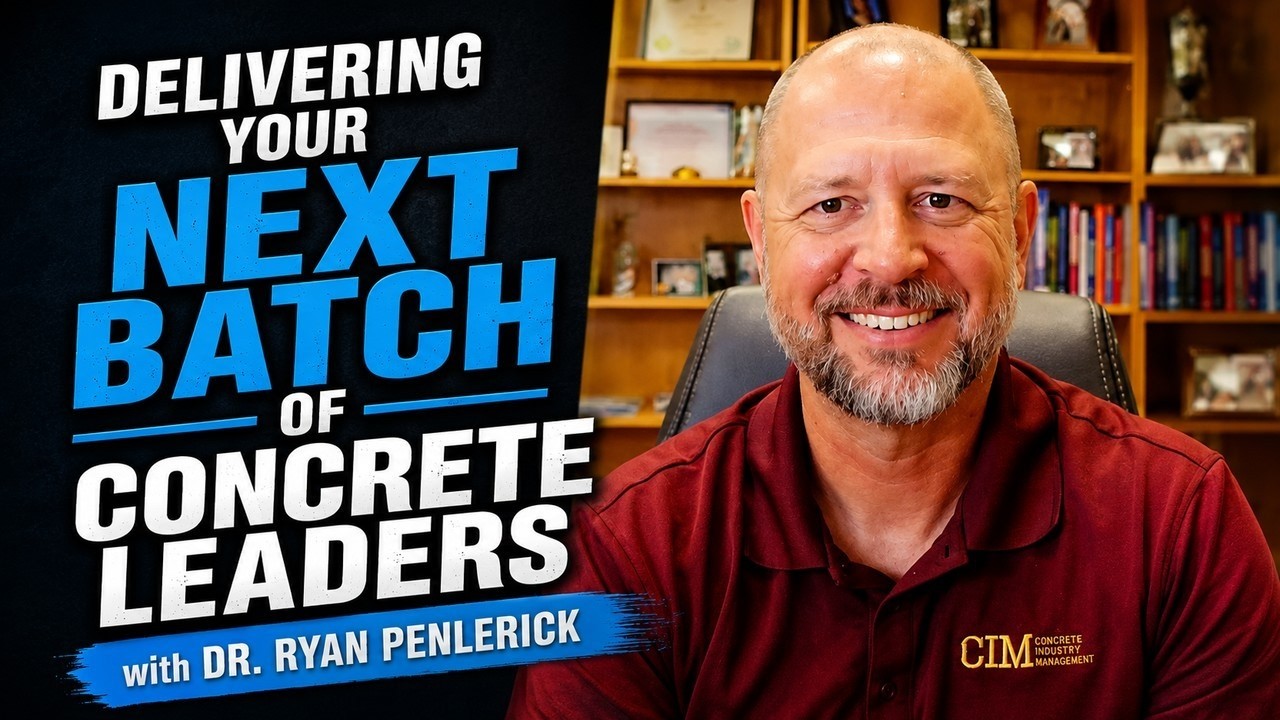


In this episode of The Blueprint Podcast, we sit down with Dr. Ryan Penlerick, Program Director of the Concrete Industry Management program at Texas State University, to explore how CIM is helping build the next generation of concrete industry leaders. Ryan shares insights from his decades in construction, explains what makes CIM different from traditional construction management programs, and discusses the program's impact on workforce development, industry partnerships, and career opportunities. We also talk about leadership, the future of concrete, and why investing in the next generation may be one of the most important things our industry can do.
Joel: Hi, welcome to the Blueprint. I'm Joel Galloway. Today we're excited to welcome Dr. Ryan Penlerick, Program Director of the Concrete Industry Management Program at Texas State University. Ryan brings decades of experience in commercial construction, business ownership, and leadership before transitioning into higher education, where he's helping prepare the next generation of professionals for careers in the concrete industry. The CIM program plays a critical role in developing future leaders and strengthening the workforce that keeps our industry moving forward. Today we'll discuss what makes the program unique, its impact on the concrete industry, and how companies can partner with CIM to invest in the next generation. Let's get started.
T.J. Crosby: So Ryan, appreciate you joining. thank you, Joel, for for putting this all together. first first question is for just to tell us a little bit about your background.
Ryan Penlerick: Well, I've been around for a minute. So I actually have a degree in construction management from Colorado State University. And after I graduated from CSU, I moved down to Texas and I went to work in the commercial construction industry. So did that for one company for the first eleven or twelve years of my career. Started as an assistant project manager, worked up to project manager and then made vice president of a division. We stood up a commercial division. lived through the economic downturn of two thousand eight, nine, ten, eleven and built built up a division and then rolled up a division in that time. And two thousand eleven left that company and started my own company. So from eleven to twenty two, had my own small to medium sized commercial general contracting company, owned a concrete construction company as a as a another business unit at a real estate holding company as another business unit, residential building company as another business unit. So just kind of touched a little bit of everything in in the construction industry before I decided to jump off into the wide world of helping run a CIM program at Texas State.
T.J. Crosby: I mean, what what I mean yet so you had a lot going on. What what led you to make the jump from commercial construction and all the other verticals you were in into higher education? 'Cause that's not necessarily a linear path that people would normally expect to happen. So
Ryan Penlerick: It's maybe not a linear path, but it's something that needs to happen far more often, I will tell you. We need more industry experience in the classroom every single day. And you know, being a part of running a division of a company and then owning my own company, I've trained a lot of young people coming into the business. And just it was one of those things that I noticed over a twenty-five-year career is I felt like the students that I hired or the young the young people that I hired as graduates from construction programs in the early 2000s seemed far more prepared for the industry than some of those same students and graduates that I hired in the in the 2020s. And so as part of my master's program and then my PhD program that I started working on before I came to Texas State, that was my dissertation topic, was really trying to study why they were far less paired over a
T.J. Crosby: Mm-hmm.
Ryan Penlerick: period of twenty five years, you know, technology's getting better and and the f the students, the graduates coming out should have been better. They weren't appearing to be better. So that was really my first foray into somebody needs to go back and do something about this. And and the answer is the the research that I did and the publisher papers that I published indicate that the more industry experience you have in the classroom in an applied discipline like construction or concrete industry management, the better prepared the students are for the industry.
T.J. Crosby: Got it. Yeah, it makes sense. I mean, I think about I had a professor in my my management program that she would try to speak to her experience before she got into being in education, but it was like a junior level like assistant manager type position at like a retail like establishment, which is experienced, but it's not the same as having become like a corporate executive or something like that, right? Like it was, you know. so I I'm with you. Like a very different experience when you heard from somebody who had been a senior leader in a cor in a company and decided to go back and to kind of give back to education. so I mean, and then CIM specifically. So that was it's not been around a long time, 30 years, it's been around I guess a while, but like it's still a relatively new idea in academia. what what made you decide to get into CIM specifically?
Ryan Penlerick: Well, there was an opportunity. And I was
T.J. Crosby: Okay. That's fair.
Ryan Penlerick: I was I was teaching as an adjunct instructor at Texas State in the construction
T.J. Crosby: Mm-hmm.
Ryan Penlerick: management program and this this CIM director position was was vacant at the time. And I started talking with Dr. Wilde, the department chair here, about what it is, what it was, how it was related to the construction industry and it just seemed like the right fit at the right time and and I knew it was an opportunity. It was something that that spoke to me because of the specialization within the concrete industry for it's still it's still very largely a construction degree, but it's a specialized construction degree in the concrete industry. And I I looked at it and, you know, Texas State's program was struggling at the time. Very few students in the program. The industry engagement had fallen off and I looked at it and said there's no reason why any of this should be happening other than a lack of knowledge about the program. So jumped in both feet and here we are starting my fifth year, my fifth academic year this fall. So all good things.
T.J. Crosby: Yeah, I didn't realize I've been in the industry only for three years. I didn't realize that 'Cause you know, kinda when you get into a new situation, you kinda feel like whatever is is the way it's been for a long, long time and I had no idea that you'd only been doing it for a couple of years right when I first got in. I mean, kudos to you that you've definitely turned the tide on the awareness and the involvement. I mean, the CIM students, especially Texas State, like very visible, very involved in a lot of different places. I know that it's a lot of hard work and planning to do all that, but kudos that you've you've done that. Yeah.
Ryan Penlerick: be surprised. I'm gonna talk over you. You would be surprised. We've done a lot of hard work and we've done a lot of great work and we are building the brand of CIM and building the knowledge base, but I can still walk out into the industry thirty miles from here and I can walk into a precast plant or a ready mix plant or a construction job site and there are the vast majority of people have no idea what the CIM degree is. Still. So that's
T.J. Crosby: Mm-hmm. Mm-hmm.
Ryan Penlerick: you know I do podcasts like this and talk to a lot of people and that's the primary function is people need to know what this is and understand it. The value is incredible to the industry, the value is incredible to the students. It's just education. People need to understand.
T.J. Crosby: Right. No. So in that sense, if you get to give a quick commercial for what the CIM program is, and what makes it different from a traditional construction management degree, what's your kind of your elevator pitch for that?
Ryan Penlerick: Sure. Well, the you mentioned it earlier, the
Joel: Yeah.
Ryan Penlerick: degree program's been around for thirty years now. It started at Middle Tennessee State University back in the late nineteen nineties. And it was born from an idea that we were in a p period of consolidation then, much like we are in a period of consolidation now. And these smaller mom and pop type of companies were being gobbled by the larger corporations, and those smaller companies were owned and operated and managed by dad and mom and grandma and grandpa and uncle and brother and sister and it was family business. Well when you when you get gobbled up and most of those folks work out their couple of year non-compete, then the corporation is standing there going, Who's gonna run this plant for me now? And
T.J. Crosby: Mm-hmm.
Ryan Penlerick: hiring hiring business graduates that understood a thing or two about business but knew nothing about concrete as a material and as a product didn't work. And hiring construction management graduates who knew a little bit about construction but didn't know construction or or maybe even business that well didn't work. So they said, let's create our own degree that gives us the talent that we need to do what we do. And so Middle Tennessee started it, Cal State Chico and NJIT got it in two thousand and six, two two thousand and nine it came to Texas State and then South Dakota State University is the most recent, joined in twenty twenty one. So
T.J. Crosby: well. Yeah.
Ryan Penlerick: Five programs distributed around the country and we are educating the workforce in concrete materials, concrete material science, concrete businesses from ReadyMix to Precast to chemical admixtures, some into the aggregates world, many into the cement world, and even concrete construction itself is a big place that we we send our graduates because they need to know, they need to know the material. They need to understand how concrete works, how it behaves, and how we use it.
T.J. Crosby: Yeah. I think I think for the typical kind of layman out there, myself included a few years ago, don't have an understanding of how complex concrete can actually be as far as all the different applications and temperature variations that happen in different parts of the country and the environment that it's going to be used in and like to finish it has to have I it's it's wild, the science that goes into it. It's something that seems very simple on the surface when you see people pouring concrete and finishing concrete on the sidewalk. But the longer I've been in this industry, the more complex I've realized it is, which is it was wild. I've been the skate for concrete program. And when they talk about the materials they use to make their their miniature skate parks, it's just it's like wow. Like even for those different applications, they all have different and then the additives for color and you know, do you dye it, do you stain it? It's just it's it's wild.
Ryan Penlerick: It's incredible how vast it is. I I'll tell you my my my pitch to high school students, because that's always the the always always the challenge. We're recruiting for a program here, but we're also recruiting for an industry. They're gonna come through this program, but they're coming to an industry. And one of the one of the most successful things is this analogy that I've that I've kind of created and talked about for years now, is a way to
Joel: Right.
Ryan Penlerick: explain what we are and how we're different from construction management. Or business. And it really landed when I started saying, all of you high school kids, you've been to the doctor, right? You're sick, you got a sniffle, tweak your knee, you need an annual physical, where do you go? You go to the family doctor. When you find out, that tweaked knee is a torn ACL, where you go. You go to the orthopedist, you go to a specialist. And that's that's what we are. Construction management students, graduates, construction managers, they're the generalists. They're the family doctor. They know a little bit about a lot of things. And we are, concrete industry management, the cardiologists of construction. We are specialized, deeply specialized in one sector of the industry. Some people might say we might be the proctologists of construction. I don't know. But I like the cardiologists better.
Joel: Yeah.
T.J. Crosby: I think I think the cardiologist is a is a fair comparison because one thing that's a little different about concrete compared to some of the other trades or subcontracting aspects of construction is how much risk is involved if concrete is not managed properly. It's just the failure risk and you know, kind of obviously take for granted that you're in a 60-story building and you're kind of relying on everything to work properly or you're Parking your car on a parking deck, and you just kind of assume that that, I mean, honestly, relatively thin layer of concrete is gonna hold your car up and among all the other cars that are there. And it does because it's it's done well. But it's I think the cardiologist is a very apt specialty to relate it to. so if you were to to talk to the companies that are hiring CIM, let's say obviously we all need to be super involved, and as we're trying to get more involved in. Getting the high school students to come into the industry, even mid-career transition people to they might be pursuing a degree a little later in life to come into the industry. But if you're talking to the employers as they consider supporting the CIM program and and pursuing a CIM graduate, what skills are they getting that they may not otherwise have gotten? You touched on it a little bit, but if you were to kind of like really focus on that part, what are they getting that they may not otherwise have gotten?
Ryan Penlerick: Well, we know that the concrete industry is broad and vast and specialized, but there's a lot of things that we deal with in the CIM program that are directly applicable to the things that ready mixed businesses or aggregate businesses or again admixtures, cement, all of them do every day. Quality control and quality insurance. You
T.J. Crosby: Mm-hmm.
Ryan Penlerick: look at again, a business degree, a co a construction management degree, there's there's very little time spent, if any, on Quality control, quality assurance processes
T.J. Crosby: Mm-hmm.
Ryan Penlerick: in those degree programs. So an entry-level position in a pre-cast plant or a ready mixed plant oftentimes is a quality control technician. And our students are coming out and they understand quality control, they understand quality assurance, they actually have a certification, an industry recognized certification coming out of this program, their ACI field grade one. So we are
T.J. Crosby: Todo.
Ryan Penlerick: delivering things within the programs that are meaningful to the industry now, today. And again, educating the industry about what that means. And someone who owned a business and understands what it costs to train someone in the
T.J. Crosby: Mm-hmm.
Ryan Penlerick: way we do things in our business and understands what it costs to lose a person that's fully trained and and trying to trying to make those connections with business owners and business managers in the concrete industry and say, There's a lot of value here. There's a lot of
T.J. Crosby: Mm-hmm. Right.
Ryan Penlerick: value to hiring a CIM graduate. There's a lot of value to supporting the CIM program because if you don't, you're spending money anyway. You're spending
T.J. Crosby: Mm-hmm.
Ryan Penlerick: money to train people to do the things that we're already training them to. So come talk to us, come see us. In fact, come help us recruit. Talk to people, talk to families, talk to students in your in your town, in your city, in your county, and recommend, hey, you've got to Great career opportunity here. Go to Texas State. I'm only gonna plug Texas State today. Go to one of the CIM programs, but go to Texas State and go to the CIM program and then come home and go to work and you're gonna have a career that lasts a lifetime.
T.J. Crosby: That's great. One thing I heard the other day talking to one of the other leaders in the CIM program was that a lot of the universities have worked it out where some of the kind of regional areas that that students may be living near one of the five hubs might have some way to offset in state versus out of state tuition and that sort of thing. So some people might be like, well, that's not in the same state I'm in. I might have to pay, you know, through the nose for that. But I've learned that there's a lot of scholarship support. There's also things to offset the in state versus out of state, to help keep costs down, right? Is that that true of of Texas State? I would assume it is, but you know, you're talking about Texas State specifically. What's
Ryan Penlerick: Absolutely.
T.J. Crosby: yeah.
Ryan Penlerick: Yeah, absolutely true. And first, there's an incredible amount of scholarship opportunity for CIM students. Again, differentiating from business and and construction management, there are hundreds of thousands of dollars available that are targeted specifically to CIM students. And that money you're a big fish in a small pond, right? you're you're competing with a very small, relatively small number of people when the money is set aside for CIM students only. that money comes directly from the industry, whether it's from the National Steering Committee, the the conglomerate of corporations and and individuals that are part of overseeing the five programs, or whether it's our local patrons board foundation that's the more local ish, Texas ish companies that support us support us locally. There's there's There's money. There's money to support that. In addition to that, if you're an out of state student coming to Texas State, we've got opportunities to to get you in state tuition. So don't let that be an obstacle to coming to Texas State. There's there's an answer to every question. We solve problems.
T.J. Crosby: There you go. There you go. And not to mention, a lot of students that they come out with more than one job offer, right? So like you have money to help you go in and you have money coming out.
Ryan Penlerick: That's exactly right. There's an incredible amount of opportunity. You know, I I we we advertise, we promote that we have 100% job placement for our graduates and we do, but it's really probably like five, six, seven hundred percent job placement because that's how many job offers every one of our graduates ends up having. So
T.J. Crosby: Yeah. Yeah.
Ryan Penlerick: it's it's it's it's really pretty fantastic.
T.J. Crosby: Yeah, it's pretty pretty crazy, just considering I mean, so when when a company invests in the students, I mean you made obviously the the the largest sacrifice you can make where you stepped away from being in the industry and on the kind of the construction side and stepped into academia, but companies that invest in the students, what what do you see happen in those relationships, would you say compared to the companies that don't take the time to spend time investing in the students, would you say?
Ryan Penlerick: The companies that spend the time and money and effort in investing in the students are the ones that reap the benefit. So
T.J. Crosby: Mm-hmm.
Ryan Penlerick: what we do know, what is absolutely 100% evident in the data, is when you are engaged with the students in this generation, they will be engaged with you. And we have an internship program. 100% of our students are required to complete one internship in their time at Texas State, a summer internship. Most of our students are doing two, three, sometimes four, depending on how long it takes them to get out of here. But the companies that have internship programs are the companies that hire our graduates. Almost one hundred percent of our students go to work for a company they interned with. They go, they they understand the company, they understand the culture, they get ingrained in the company culture, and they want to return to that company. There's a comfort level there. This the companies that aren't participative. The companies that I get phone calls from weekly if not daily saying, Hey, my I I I just lost a salesperson and I need do you have a CIM grad coming up that that I can that I can talk to? And I say, I mean, sure you can talk to but it they probably already have a job if if not four or five offers and they don't know you. So for them, I mean, you're welcome to throw mega bucks at and see what happens, but There's there's no comfort level there. There's no there's no relationship there. And we
T.J. Crosby: Right. Right.
Ryan Penlerick: really, really, really pride ourselves on the relationships that we build for these students during their time in the program.
T.J. Crosby: Yeah. And it's cool to see the you like some of the trade shows that we go to, we see companies that will kind of two or three companies come together and we'll take the CM students out to dinner and and you know, it's just it's just cool to I mean, I think that's fair been fairly unique in my experience. I've worked in a lot of different industries and seeing an industry wrap its arms around students in that way and and really kind of recruit them into the industry, it's pretty cool. We do need more of it for sure. but it's cool to see it that it exists and then Like anything, if people haven't woken up to this by now, and I think some people are still waking up to it, that there is a talent shortage to period. Like not even just in our industry in in general, in this country, specifically in construction and especially in concrete, there's a talent shortage and there will be the haves and the have nots, the people that don't invest the time to create talent coming in, to recruit talent to come in, to invest in the internships. It's not a matter of, it's gonna be harder for you to hire. In my opinion, it's been matter of you cannot continue to operate because you will not be able to take on the work. And eventually you'll be one of the ones gobbled up because others prepare better for a time like this, you know. and I've I said that not in a joking way at all, very seriously. It will be the difference in being a successful company long term or not, in my opinion. So
Ryan Penlerick: It is a it is a mindset shift that the industry has to make. And it it's the tide is maybe turning a little bit. But I spent a lot of time on this talking with folks at TACA, Texas Aggregate Concrete Association. So the TACA Conveyor Magazine, pick up a copy if you don't get it. But I I put an article in there quarterly when that magazine comes out. And all of last year, all four quarters of of my article. Was related to just that topic right there.
T.J. Crosby: Mm-hmm.
Ryan Penlerick: Having an internship program, for being involved with the program, and what I call building bench strength. We all suffer from the same affliction where if I need ten people to operate my plant, I'm gonna hire ten people and I'm gonna have ten people. And when one of those people leaves, I need another I need that tenth person right now. And that person Isn't there right now? So if I need ten people to operate my plant, it might behoove me to have eleven or twelve and have some people on the bench. Is it cost efficient in the in the moment? Maybe, maybe not, but is it cost efficient when that person leaves that you can't replace today and you can't operate your business? People have to start thinking about things differently. And that's that's some of the things that we try to help with from from an experience standpoint here at at Texas State, educating the business, educating the industry on on the way things are changing.
T.J. Crosby: Yeah, no, for sure. I mean, I'm I'm curious for you as a person What your your do you find yourself having to sometimes ring the bell of making sure that they understand that you came from the industry? That you weren't you know, 'cause there might be an assumption like, you've been a professor for thirty years. It's like, no like you know, I
Ryan Penlerick: Yeah.
T.J. Crosby: mean, how often does that come up in your conversation to help people know that you've got the pedigree to kind of you put your money where your mouth is, so to speak, like to to get involved? I think it definitely would resonate differently for people than assuming you've been academia your entire life. No disrespect to people that have chosen that that path, but in a very hands-on industry like ours, there's definitely a level of credibility you get when you've been there and done that. Right.
Ryan Penlerick: I think, you know, I'll I'll I'll continue to plug and push for the fact that we need more industry experience in the classroom. And
T.J. Crosby: Mm-hmm.
Ryan Penlerick: the more these programs grow, whether it's a construction program or a CIM program, getting industry experience faculty in the classroom is incredibly important. And yes, I can sit down in a room with industry professionals and understand exactly what they're going through because I lived it and I dealt with it and I know. what they're what they're dealing. I understand what it's like to have PL responsibility. Been there done that. So
T.J. Crosby: Mm-hmm. Right.
Ryan Penlerick: the decisions that have to be made, they're we can't only look at cost and expense these days because the cost and expense, you know, like I said, operating a PL, having that extra person on the payroll, but what is the what is the cost of retraining? And those are
T.J. Crosby: Mm-hmm.
Ryan Penlerick: the those are the hidden costs that we don't often recognize and we need to, because they're real. Those the things with my background, with my experience, with the things that I've done. I hope people recognize it. I hope people appreciate it. I think they do. With you know, there's
T.J. Crosby: Mm-hmm.
Ryan Penlerick: there's a lot of you out there that have known me for a while now, and and you do a great job of saying, hey, this CIM program has a lot of experienced, industry experienced faculty in different places around the country. They know what they're talking about. Let's let's support them and help build these programs.
T.J. Crosby: Mm-hmm. To to that end, if somebody was considering making a career transition to to get involved more actively and support becoming, you know, joining the faculty in some way, how do they need to prepare? Like what do you think they need to consider for themselves to be able to prepare to step into that that type of role?
Ryan Penlerick: The good news is, TJ, I don't know if people are gonna feel like we worked together on these questions. We really didn't. But number one, we have a faculty position available right now. Come work for Texas State, faculty
Joel: Yeah.
T.J. Crosby: Love it. Right.
Ryan Penlerick: of practice. So there's there's different positions here in in academia. The position that I'm in is called a faculty of practice or a professor of practice. In a fac in a faculty of practice position, you are hired specifically for your industry experience, irrespective
T.J. Crosby: Mm-hmm.
Ryan Penlerick: Almost of what degree you have. When I say almost, it's not quite. But you don't necessarily have to worry about having a master's degree or a PhD. We are hiring you because you have industry experience and that's what we want to deliver in the classroom. Preparing for that is you industry folks have all of the knowledge in your head. But maybe you've never taught before, you've never worked on curriculum development, you've never put together a rubric or a homework assignment. So there's there's a lot of things that you can do on your own and learn, you know, how to teach. There's there's programs out there to help you learn how to be a a teacher, be an educator, be a trainer. come to work for us, you don't have that experience, guess what? We're gonna we're gonna get you that experience. We're gonna we're gonna send you to programs, we're gonna send you to sessions. I mean, our crediting body. For one, ACCE has a program called the TLP, Teaching Learning Practitioner. It was developed specifically
T.J. Crosby: Mm.
Ryan Penlerick: to help people learn how to teach construction and concrete related content.
T.J. Crosby: Right, right. Yeah. I mean, don't don't be nervous to get involved in education because they're gonna educate you on how to be involved in education. Right. That's I mean, that's what
Ryan Penlerick: Exactly.
T.J. Crosby: what the whole idea is, right? To help people learn. That's that's great advice. so two questions I have for you personally is what advice would you give yourself at the age of twenty five? Starting starting out in construction, or maybe you had been in it for a few years, but fairly early on. what what advice would you give yourself at this point in your career?
Ryan Penlerick: medical school
T.J. Crosby: Ha ha ha ha!
Joel: Yeah.
Ryan Penlerick: i'm just kidding
T.J. Crosby: That's the opposite of coming out without debt.
Ryan Penlerick: i'm just kidding i love this
T.J. Crosby: Yeah.
Ryan Penlerick: industry i'm a i'm a construction person through and through and and and i love training and teaching and working with the young generation but the i the the advice i would give myself is the advice that i give these students every single day build a network Build a network with your classmates, build a network in the industry, get involved with industry associations and industry organizations as early as possible because that network is the people that you're going to rely on. You're going to rely on them to get yourself through this program. You're going to rely on them when you enter the industry. They're going to work for you. You're going to work for them. You're going to buy from them. They're going to buy from you. So having those relationships is so important. And then Eventually you're going to elevate to a leadership position. And when you elevate to that leadership position, that network of people that you've built are the people that you want to surround yourself with in your business that you want to hire. Hire people smarter than you. Hire
T.J. Crosby: Mm-hmm.
Ryan Penlerick: people more talented than you, because that's what it takes to operate a business today.
T.J. Crosby: Right. Right. Good. Joel would say that in my case it's not that hard for me to do to hire people that are smarter and more talented than me, but other people that might be more challenging, you know.
Ryan Penlerick: Well, me either.
T.J. Crosby: but it's great. I mean, it I think one thing I've I've realized over over the last few years, people hear the idea of networking and they kind of get a little bit confused about what it is. And you've said it already, but I'll kind of reiterate it's relationship building. It's it's go go create relationships. People think about networking as some kind of like this like thing of gotta have business cards and whatever. But I I think about I think it's Kate and and JP, right? Joel, was that yeah.
Joel: Yes. Yep.
T.J. Crosby: I mean, literally just came up to us at the pre-cast show this year. I think it was still this year, 2026, but
Joel: Yeah.
T.J. Crosby: and we're like, hey, we just want to come say hello. We're like, nice to meet you. And now, like, we know who they are. They know who we are. Simple as that. And we chatted for a while.
Joel: Well, they were like, We saw you on Linked we see y'all on LinkedIn all the time. And so we wanted to come say hey. And it was just like the circle, you know, just all these
T.J. Crosby: Yeah, right. We're like
Joel: things we're doing. It's like
T.J. Crosby: Yeah, yeah, exactly. They saw us and but but the to come up
Joel: Yeah.
T.J. Crosby: and just say hello, like some people be like, well what's what what benefit was it for them? Like I don't know. You know, I mean they don't need a job because it's you know, multiple roles offered to people when they come out of the program, right? But you never know, one day, you know.
Ryan Penlerick: We harp on it. We harp on it constantly in the classrooms. You know, as you know, you mentioned you ran into those two young men at the precast show, but that's another unique thing to the CIM program because of the financial support we get from both the National Steering Committee and our local patrons board, is we have the ability and the funds to take students to industry trade shows, industry events around the state,
T.J. Crosby: Mm-hmm.
Ryan Penlerick: around the country, and sometimes out of the country. And those are incredible. To me, those are some of the most unique. and rewarding opportunities in this whole educational enterprise because we take those students and we put them in a position where they're uncomfortable. They're having to talk to people that they're they're intimidated by. You know, these presidents
T.J. Crosby: Yeah.
Ryan Penlerick: and vice presidents and CEOs and chairmen of the board and and you know the more they do it, the more they repeat it, they have more success. And it is a differentiator for our students. They we get more compliments and say your students Ryan, your Texas State students, what you're doing professionally for them to be able to walk into a room, work a room, shake a hand, look people in the eyes, have a conversation. You know, it's pretty incredible. I'll tell you, Rob Van Till, you all know who Rob Van Til is. He is the
T.J. Crosby: I love Rob. Yeah.
Ryan Penlerick: outgoing chairman of our patrons board. And he just texted me last week. He was in the airport in Minneapolis, of all places. And two of our Texas State CIM students walked up to him in the airport and remembered him from a guest lecture on campus and walked up and shook his hand and he took he took a picture of selfie and sent it to me and said, This is incredible. They remembered me number one, and number two, that they would, as freshmen, walk up to me in the airport in a different state and come say hello. So he'll remember them and they'll remember him.
T.J. Crosby: That's amazing. And yeah, and
Joel: You're doing something right.
T.J. Crosby: quick plug for the parents who might happen to watch this episode is that's indicative of how the industry receives these students as well. Like I'll say, like
Joel: Yes.
T.J. Crosby: Rob's Rob's reaction to them taking the selfie and having a chat is not atypical. A lot of people in this industry are very warm, very welcoming. it's
Joel: Yes.
T.J. Crosby: not an industry that you kind of come in and it's like doggy dog kind of a vibe. It's very relational, very collaborative, almost sometimes surprising to me coming from the private equity world that I came from. It's a little more, you know, get what you can get, kind of a vibe. And this industry is much more, let's figure out how to build this together, all the associations that exist, all the different conferences, is just so much opportunity to relationship build and to collaborate and to learn from each other. And it's gonna be hard to find an industry that's as warm and receptive to people coming in and learning and getting to know walking up to an executive and that executive views themselves just like a regular person like anybody else. Like it's not, you know, that they are, you know, came from an ivory tower kind of thing. I mean, everybody in in concrete everybody gets dirty at some point in their career. You know what I mean? And so there's just a level of humility I guess, you know.
Ryan Penlerick: Yep. It's an interesting thing. The the National Steering Committee had a study done. It's been a few years ago now, and it's hopefully it's something that that we're gonna to do again. We need to do it again. But I'm gonna say f five or six years ago, they they did a study of retention within the industry for CIM graduates. And that number was well north of eighty percent. So you come through this program, you get this degree and you go to work in the industry and you stay in the industry. I mean it's you are doing what you meant to do, what you what you want it to do and obviously it A pays well enough and B doesn't dur doesn't burn you out and and ruin your life that you want to stay and make it a career. So it all good things and it's a great thing to say about the industry and and put that on the top of the list of we need to do this study begin again.
T.J. Crosby: Right. Yeah. That's a good idea. all right. So just a couple more questions for you. I know we're we're we've had you talking to us for for a minute here, but you know you've you're uniquely positioned to understand, especially in Texas, because there's so much going on in Texas in the concrete industry and the construction space specifically, but what excites you the most about the future of concrete? would you say just from your your vantage point?
Ryan Penlerick: Well, whenever we talk about the future today, what do we have to talk about? We have to talk about AI, right? We have to
T.J. Crosby: Mm-hmm. Right.
Ryan Penlerick: and the interesting thing about AI is AI, I think we recognize it's displacing people in a lot of industries. I don't see that anywhere in the near future or maybe even the distant future in
T.J. Crosby: Mm-hmm.
Ryan Penlerick: concrete industry. Are we using AI? Absolutely. Are there tools that are helping us do our jobs better in the in the concrete industry? One hundred percent. Is AI displacing anyone in the concrete industry now or or or in the foreseeable future? No, I don't see it. So we used to say, and we still can say, you know, your your job's not going to be outsourced overseas either. And you know, it's we concrete's a perishable local product. You know, this ninety minute, ninety mile ish radius of, you know, if you want to You want to go back to your hometown and work, you can. I guarantee you, there's a ReadyMix plant, there's a precast plant, there's something because it's it's a locally manufactured, locally made, locally delivered product. And so the the future is strong. Population growth in Texas, especially, I mean, some of the statistics that we're seeing on predictions for the next five, ten, fifteen, twenty, thirty plush years for Texas is it just continues to grow. And it's already the number one state, number one producer, number one consumer of concrete and concrete related products in the country. By
T.J. Crosby: Mm-hmm. Right.
Ryan Penlerick: by more than double. I mean, California and Florida are are two and three and and we are more than them combined, so and only grown.
T.J. Crosby: Crazy. Right.
Ryan Penlerick: It's just the opportunities never end in Texas and you know, absent something completely batty happening. We we went through COVID and it was pretty, pretty wacky and We didn't miss a beat, right? So I think there's a lot to be said about getting a career in something that you know is has a bright future.
T.J. Crosby: Yeah. And I think that's one thing I'll say too for people at some of the AI in the future that's appreciate you sharing that. But there are people who are very technology centric, especially like on the applied technology side. There's exciting opportunities in our space to come in and use your kind of that that side of things to help with some of these, you know, whether it's like the chemical design of some of the concrete mixes or how the systems and tools can you know, measure the quality of the concrete. And I mean, there's just so much and there's so many technology companies that are coming into this space and finding investment. So I would say even if you're you know people might view technology or concrete is like a very kind of blue collar style style place. And obviously it it is it is to an extent, but beyond even the management side, there's a lot of kind of traditional corporate type roles that could come into this industry and have a similar job security and a similar kind of long term outlook and growth and not be as it's a very I I I use this as a pun intentionally, but it's a very solid industry. concrete is and it it applies for anybody, not just the people that have the kind of construction and management focus, but any of the other fields too that could come in. It's we're we got arms wide open. Come come in, the water's fine, you know.
Ryan Penlerick: The technology piece, the technology piece is amazing and it's changing every day. If if high school students knew and understood the amount of technology that was incorporated into a ready mix truck alone. I
T.J. Crosby: Mm-hmm. Right.
Ryan Penlerick: mean, that's one of our most popular things that we've done is is we have a concrete day usually in the spring and we invite high school students and and community college students to come in and we Frank Beck. Beck mixers is right down the road from us here, and they manufacture
T.J. Crosby: wow. Yeah.
Ryan Penlerick: Ready Mix trucks. And so they brought a brand new, straight off the lot Ready Mix truck up here a year ago and parked it. And we were just walking through, and students, high school students were amazed at the amount of technology and computers and GPS tracking and all of that stuff that's on a modern Ready Mix truck in 2026. So again, it's all about education. People just don't understand the end. industry, they don't understand the business. They don't understand what we do.
T.J. Crosby: Yeah. Yeah. And that's where people like you and what we're trying to help here too, getting the word out. I think one thing that's crazy, you know, we there's creating this this job board. the mining industry is very related, like it's a sister industry basically. They they've had an industry wide job board since the nineties. And concrete industry, that's like a new it's I there's been attempts at it, but like it's a new advent and like fingers crossed that we do it well and build it properly, but it's It's just there's just a lot of need to get the word out of how robust this industry is, how many opportunities there are. and y'all are doing strong work getting the word out there, to people within the industry to be involved in CIM. But like you're you're right. Like as an industry, we need to get the word out even more broadly that the concrete industry, period, is a is a place to come and and be and to learn. And yeah, parents want to make sure the kid has a degree that's worthwhile. CIM, hands
Joel: Okay.
T.J. Crosby: down. It's one of the strongest out there to go get and be set up for a really strong financial future. so in in kind of in closing, couple questions for you. Where can people go and learn more about the program or get involved?
Ryan Penlerick: Lot of different places. So we talked about industry trade shows, industry meetings, things like that. CIM students, CIM faculty, CIM National Steering Committee members, CIM patrons board members for the various universities. We're just about at everything. So find us, find me. we want to talk in person, right? Networking, build the relationships. We want to talk in person.
T.J. Crosby: Right. That's right.
Ryan Penlerick: You know, we've got Concrete degree dot org website, the CIM national website. It'll link you to all five programs, individual websites. It's a great place to go take a look. You know, most of us, if not all of us, have LinkedIn presence for not not only our faculty but our programs. You like you like the other social media, we're on we're on Twitter, we're on Instagram, we're we're on everything but TikTok because we just can't we're just not allowed to TikTok at at this particular time. So
T.J. Crosby: Yeah, I get it. I get it.
Ryan Penlerick: Well we love to be able to meet the students where they are in that, but it is what it is. But we we've got a social media presence and come see us. We're here. We're open for business. You wanna come check out the lab, come sit in in a class, you wanna come guest lecture and talk to our students, come to a career fair, come to a patrons board meeting, we're we're open to any and all of it.
T.J. Crosby: That's awesome. That's awesome. All right. last last question. If you were to be talking to a young person entering the industry or even to my kind of mid career entering the industry who might want to be considering going back to get a degree at this point, what are What are what are three things that have to be on kind of that blueprint for success for them, would you say? Like that they have to be thinking about as they come into this this industry and to and come to learn.
Ryan Penlerick: When you come into this program as a freshman, I teach our freshman intro class and that freshman intro class we really harp on a lot of things and and we talked about it already. Build that network.
T.J. Crosby: Mm-hmm.
Ryan Penlerick: The only way you build that network is by getting involved. So success in the CIM program is not because you got the CIM degree. That's actually the easy part. I mean, you can you can show up to class and you can do the work and you can get the degree. And you are not going to have the same kind of success of a student that got involved, got involved with their peers, got involved with student clubs, got involved with industry organizations and travel. I mean that's the key to unlocking this. And that that involvement is what pushes you and propels you into your future. So the network, the involvement, and put in the work. This is a this is a difficult industry. You know, I I I I kind of got another analogy that I I talk to those freshman students about is the difference between hard and challenging. Hard
T.J. Crosby: Mm-hmm.
Ryan Penlerick: is there's a pile of concrete waste in the in the yard and here's a sledgehammer, go break it up. I mean that's just that's hard. There's no ifs, ands, or buts about it. That's hard. If I say there's a pile of concrete debris in the yard and there's a whole shed full of tools over there and there's all the equipment and here's all the staff and here's a here's a cell phone with all the contacts for all the subs and trades you need. And here's a budget and go figure it out. I need it gone by the end of the day. That's challenging. It's not hard. You're not just breaking rocks by hand. It's you have to figure out within all of these constraints how to get the job done. And that's what we teach in the CIA.
T.J. Crosby: Yeah, that's amazing. Great, great advice. and Ryan, really appreciate your leadership in the industry. Appreciate how active you are on social media and getting the word out for opportunities for the students. I see all the time you're sharing, you're tagging the CIM program for Texas State to make people aware of different opportunities. That's amazing to see. And just your leadership of the space. Appreciate you taking the time to come talk with us. It's a very important program. we want to make sure we get the word out there. Consider you a good friend. Been glad to get to know you the last three years or so and excited to see where the program continues to go from here, for sure.
Ryan Penlerick: Absolutely appreciate you having me and I guess we will see you probably in October at in our MCA concrete works, right?
T.J. Crosby: That's right. We'll be there for sure.
Joel: Yeah.
T.J. Crosby: All right.
Ryan Penlerick: All right. Thank you guys.
Joel: TJ Ryan seems so invested in the CIM program from such a genuine place. I I can't imagine someone representing it with more heart and passion from from a place of seeing the actual benefit better than he does. He's great.
T.J. Crosby: Right. Yeah, he's he's super invested. I mean, the amount of time he spends traveling with the students, the amount of time he spends talking to people about the program, about how to the advocacy for the students. I mean, he's he clearly is passionate about the mission of CIM and especially Texas State specifically. And it's not I mean I I again for me as I observe other industries, I've not seen other people get as involved, especially from the academic side in the industry itself. And then Ryan specifically, I think stands apart even among his peers, to be honest, and how involved he and his students are as a program. And so I think, you know, kudos to him that they are so visible and they're out there and he's involved. And yeah, we need more. We need more to do that. Cause the more people that out there carrying that message, the people are going to want to get involved and and realize the value of the program. Yeah.
Joel: The first my first early exposure to even hearing the term CIM was one of the students coming up to me at my very first concrete works in Florida
T.J. Crosby: Mm-hmm. Mm-hmm.
Joel: and I was blown away. I've never really been afraid to talk to people, but I know that that's a little bit more unusual than you know, and having multiple college kids come up and talk to us at the table about just what we did and telling the us about themselves and then being in the program, you can tell like the the impact that it's having. It's it's very obvious. And then hearing him speak at Taca this year, the these are things that will dramatically impact the concrete industry long term. I love being a part in a small way of having a connection to this. It's awesome stuff.
T.J. Crosby: Yeah. Yeah, me too. You know, people ask us a lot, they'll they'll ask us, like, like, are you, you know, involved in recruiting students and like from CIM into jobs? And we're like, not really, because what he said, they have multiple offers and they don't they don't need our help to find a role in a good way. Like
Joel: No. Technically no. Yeah.
T.J. Crosby: yeah, so it so it's like let's get let's get even more students in here to take this program because to his point, I mean there's there's like three to five job offers really that are available. And so that's that many people that could come out and have a role in this industry. So yeah, excited to get that word out.
Joel: big takeaway for me is yeah definitely and the big takeaway for me in all of that is the people don't know what they don't know. I mean when he said that there's people within 50 miles of the school the at at concrete plants and ready mix plants and precast stuff, you know, that have no idea about it. I that's not anybody's fault. It's just the fact of information being able to be shared and transmitted like that. It's it's just mind blowing that you can have something that really that the industry needs so desperately, you know, with especially given the the nature of the shortage of available talent and and yet it's so hard to just get the exposure that you need to the actual people who need to see it, where they can invest in it, support it, and utilize what it's creating.
T.J. Crosby: Yeah, well well, I mean, that's the thing. I was talking to N Nicole, the executive director of the CIM program nationally and about this this idea that the people that are in the plants who would love to know that CIM is an option for their their children don't necessarily know because they're not necessarily the ones going to conferences and trade shows and and things like that. And so that's why in talking about the the job board and really trying to even be even more than just a job board, trying to get the word out about the industry to the general population more and more is to make sure that it's understood by a lot more people than just kind of the leaders and executives in the industry who may already know. There's already kind of a track for them to have their their students get involved. But the person who's the the concrete delivery professional, ready mix driver, however you want to frame it, you know, they'd love to maybe know that they're Their kid could go into a program like that. and to make that available to them and make it more aware of it. so yeah, so we're hoping to do kind of our small part to get the word out there for the industry as a whole so people know. And among them, like we're also trying to support the associations, being aware, people being aware of what the associations are doing. There's so much energy around this industry to support the use of concrete, to support. the growth of the industry. It it really is a phenomenal industry. It has a great long term outlook. And so it's a little bit the kind of the best kept secret. It's in a while.
Joel: he and he's really putting his money where his mouth is because he told us once we finished recording his segment that his own daughter is going into the program this coming semester. So that's fantastic. I mean, when your kids, when you can get your own children to buy into what you're doing, no matter what it is in life, then then that means that you're you're practicing what you preach or you're you're living it and and they're they're picking it up. So that's very admirable. So wishing
T.J. Crosby: Right. That's right.
Joel: wishing her the best of luck and I'm sure she'll have a bright career. There. So big big shoes to fill for sure. For sure. Well, TJ, another great
T.J. Crosby: Yeah. Big shoes to fill. Big shoes to fill. Yeah, for sure. All right. Very good.
Joel: episode. Looking forward to the next one.
T.J. Crosby: The same here, man. Appreciate everything you've done.
Joel: And that's it for another episode of the Blueprint. Thanks for joining us. Make sure that you like, subscribe, share on all the podcasts and social media platforms. Until next time, I'm Joel.